


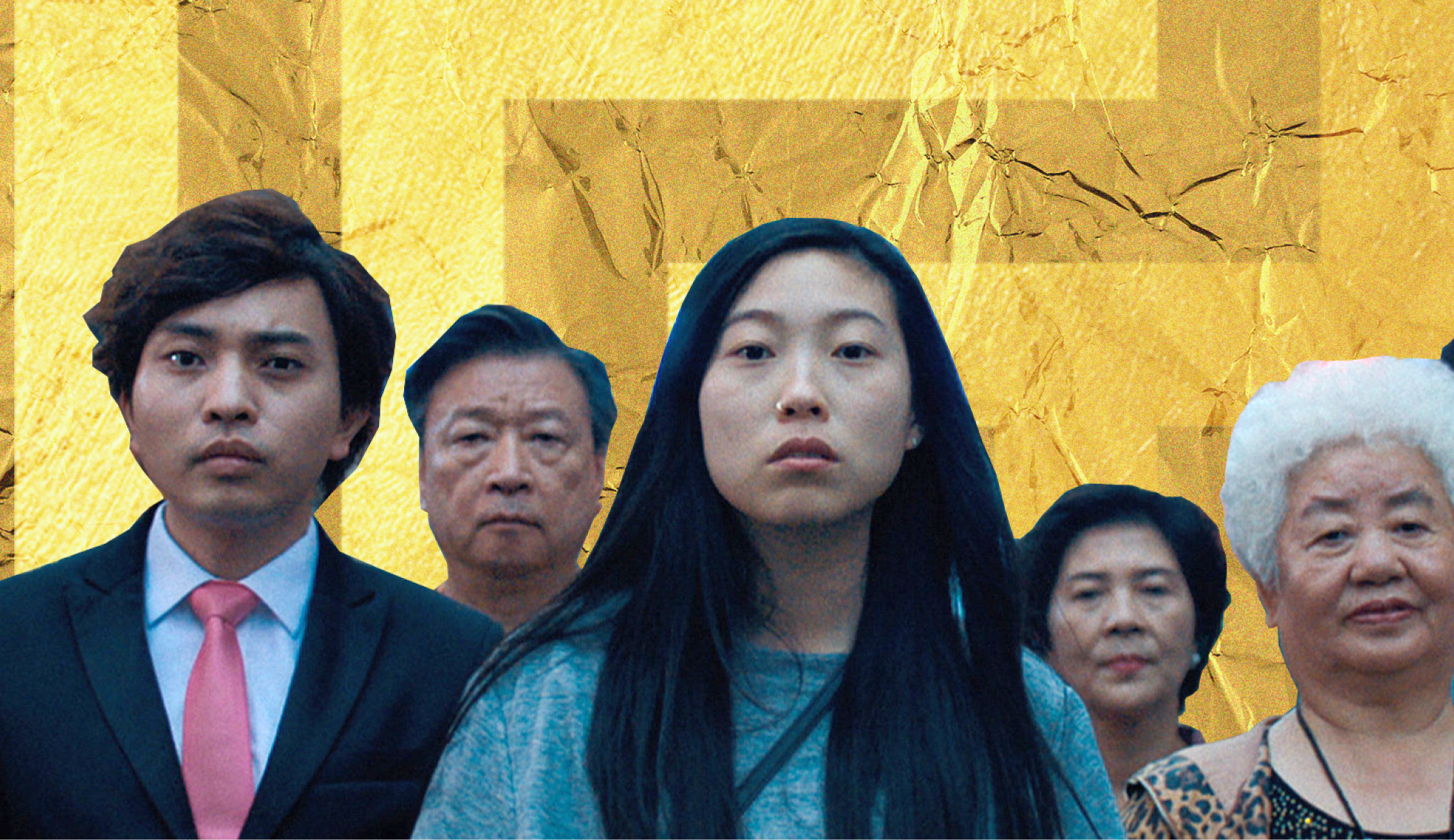
The Farewell and the #GoldOpen
For Asian Americans, this is our challenge: how do we move beyond exoticism and elevate our content to mainstream acceptance?
The Farewell and the #GoldOpen Lulu Wang's The Farewell officially debuted last week, and already reviewers are finding it impossible to resist the shallow comparison with another recent trailblazer in Asian American cinema. As a movie that smashed box office expectations and arguably set the stage for a surging trend of Asian American focused films, Crazy Rich Asians has become a measuring stick of sorts for all the movies that have followed it. With The Farewell, if you squint closely enough, you can find even more similarities: they are both stories of Asian American women facing culture clash while on trips to Asia, they both feature star-in-the-making Awkwafina, and they both dance around the emotional state of a matriarch.
On the other hand, the glaring similarities between the two are transparent: both The Farewell and CRA are two of the first, and two of the only, mainstream films that tell uniquely Asian American stories with Asian American stars -- which means we have little else to compare these movies to. In reality, the comparisons between the two films are superficial - it would be like comparing the Devil Wears Prada to The Princess Diaries because they feature white female protagonists.
The media still sees these films as inherently “Asian” films, not American ones. There’s an inherent risk in this image, that we’re headed down a path of category creation that alienates our stories, rather than normalizes them. For Asian Americans, this is our challenge: how do we move beyond exoticism and elevate our ideas to mainstream acceptance? For Asian American content creators, this is simultaneously a call to arms: how do we tell personal stories that transcend beyond our own racial identities?
The more content we produce, the more exposure we bring to the Asian American experience, the less foreign it becomes for others. It is an exciting time to be an Asian creator, and we should all be eager to support them. Over time, we will come to a place where The Farewell is seen by others as an equally Asian and American story.

In addition to its powerful story and creative prowess, behind The Farewell’s record-breaking opening weekend numbers is a group of enterprising benefactors.
#GoldOpen is an Asian American community movement where patrons buy out entire theaters for Asian American films (or other creative projects), allowing them to achieve “gold” opening weekends that pave the way for broader media and studio awareness. It originated with Bing Chen of the Gold House, which is an “exclusive collective of pioneering Asian founders, creative voices, and leaders dedicated to systematically accelerating the Asian diaspora’s societal impact while enhancing the community’s cultural legacy.” Listen to Bing speak about the how the #GoldOpen came to fruition in this podcast.
This mobilization contributed to the success of CRA, and is happening again for The Farewell: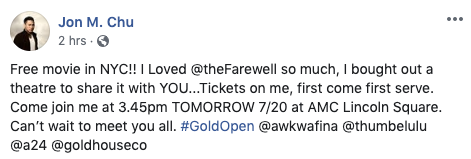
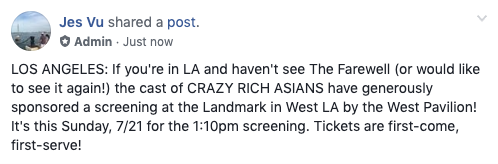 In a Western World where Asians have so little media sway, campaigns like these are a unique way of channeling Asian American economic means to directly carve out our influence. There’s something satisfyingly subversive about stubbornly gaming an unfair system to recognize the talent that our community has.
But in ten years, if we are relying on Gold Opens for success, we will have failed to find a foothold for Asian Americans in the media, or perhaps, to produce enough broadly compelling content. Today, the novelty of having Asian characters and stories is exciting, but we must strive for something more.
In the meantime, we are fully behind the idea of the #GoldOpen as an accelerant for the broader Asian American cultural identity. We loved watching The Farewell- it was an incredible film that brought us to our emotional brink, and we are grateful to the work the community is doing to spread stories like these.
The Farewell is now showing in theaters in the following cities: Austin, Boston, Chicago, DC, Los Angeles, Minneapolis, New York, Phoenix, San Diego, San Francisco, and Seattle. At time of writing, Rotten Tomatoes has it at 100%, Metacritic at 90. The trailer can be found here.
On the other hand, the glaring similarities between the two are transparent: both The Farewell and CRA are two of the first, and two of the only, mainstream films that tell uniquely Asian American stories with Asian American stars -- which means we have little else to compare these movies to. In reality, the comparisons between the two films are superficial - it would be like comparing the Devil Wears Prada to The Princess Diaries because they feature white female protagonists.
The media still sees these films as inherently “Asian” films, not American ones. There’s an inherent risk in this image, that we’re headed down a path of category creation that alienates our stories, rather than normalizes them. For Asian Americans, this is our challenge: how do we move beyond exoticism and elevate our ideas to mainstream acceptance? For Asian American content creators, this is simultaneously a call to arms: how do we tell personal stories that transcend beyond our own racial identities?
The more content we produce, the more exposure we bring to the Asian American experience, the less foreign it becomes for others. It is an exciting time to be an Asian creator, and we should all be eager to support them. Over time, we will come to a place where The Farewell is seen by others as an equally Asian and American story.
#GoldOpen
In addition to its powerful story and creative prowess, behind The Farewell’s record-breaking opening weekend numbers is a group of enterprising benefactors.
#GoldOpen is an Asian American community movement where patrons buy out entire theaters for Asian American films (or other creative projects), allowing them to achieve “gold” opening weekends that pave the way for broader media and studio awareness. It originated with Bing Chen of the Gold House, which is an “exclusive collective of pioneering Asian founders, creative voices, and leaders dedicated to systematically accelerating the Asian diaspora’s societal impact while enhancing the community’s cultural legacy.” Listen to Bing speak about the how the #GoldOpen came to fruition in this podcast.
This mobilization contributed to the success of CRA, and is happening again for The Farewell:
In a Western World where Asians have so little media sway, campaigns like these are a unique way of channeling Asian American economic means to directly carve out our influence. There’s something satisfyingly subversive about stubbornly gaming an unfair system to recognize the talent that our community has.But in ten years, if we are relying on Gold Opens for success, we will have failed to find a foothold for Asian Americans in the media, or perhaps, to produce enough broadly compelling content. Today, the novelty of having Asian characters and stories is exciting, but we must strive for something more.
In the meantime, we are fully behind the idea of the #GoldOpen as an accelerant for the broader Asian American cultural identity. We loved watching The Farewell- it was an incredible film that brought us to our emotional brink, and we are grateful to the work the community is doing to spread stories like these.
The Farewell is now showing in theaters in the following cities: Austin, Boston, Chicago, DC, Los Angeles, Minneapolis, New York, Phoenix, San Diego, San Francisco, and Seattle. At time of writing, Rotten Tomatoes has it at 100%, Metacritic at 90. The trailer can be found here.